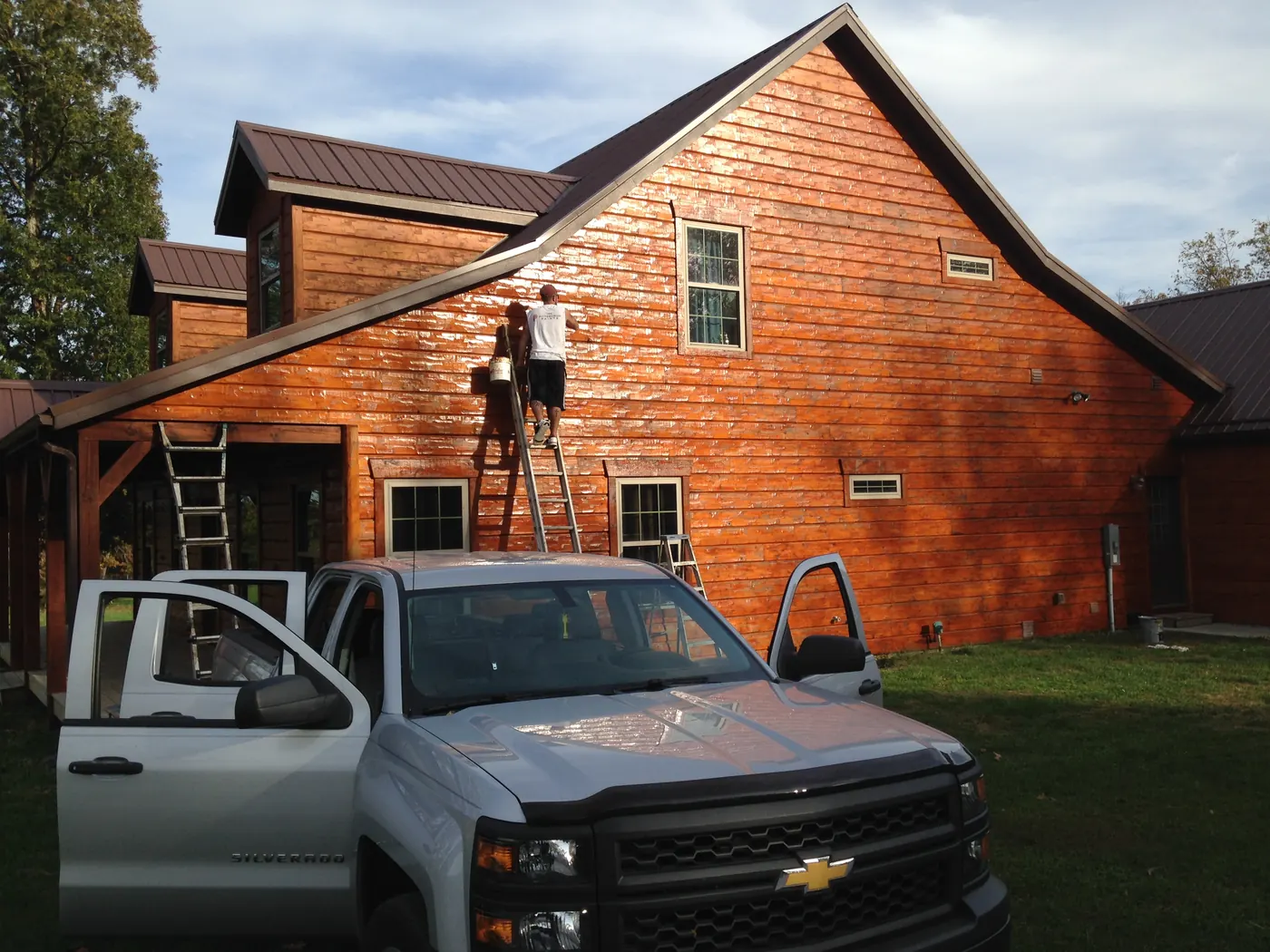
How often should you repaint a Lakewood house?
There is no single number. Sun exposure, siding type, prep and product decide it, and one side of the house usually tells you first.
Repaint a Lakewood house when the sunniest walls show chalking, fading, cracking or peeling, or when caulk joints have opened. South and west sides fail first because UV is stronger at altitude. Inspect every spring; touching up trim and caulk early can push a full repaint further out.
The spring walkaround
| Check | Healthy | Time to act |
|---|---|---|
| Rub test on siding | Little or no residue | Heavy chalk on your palm |
| Color, sunny vs shady side | Close match | Obvious fading on south/west |
| Trim and sills | Intact film | Cracks, curling, bare wood |
| Caulk joints | Flexible, sealed | Split or pulled away |
| Stained wood | Water beads | Water soaks in, gray fibers |
Why Lakewood paint ages faster on one side
The World Health Organization estimates UV rises about 10–12% for every 1,000 meters of altitude (WHO), which puts Lakewood, at roughly 5,520 feet, at an estimated 17–20% more UV than sea level. Add afternoon heat and wind off the foothills, and the west and south faces of a house wear fastest.
Stretching the next repaint
- Wash off chalk and mildew before any coating.
- Keep sprinklers off the siding.
- Re-caulk failed joints before winter.
- Choose a premium exterior line for sunny elevations.
Ready to schedule? See exterior painting in Lakewood.
What fails first, surface by surface
A house does not wear out evenly. On Lakewood homes we usually see failure in roughly this order, and it is a good order for your own inspection:
- Horizontal stained wood: deck boards, stair treads and fence caps hold snow and take direct sun, so their coating goes first.
- Window sills and the bottom edge of trim: water sits there and the end grain soaks it up.
- Caulk at corners and around windows: it dries and shrinks in the sun, then splits.
- South and west siding: chalk and fade show up here well before the rest of the walls.
- North walls and shaded areas: they keep their color but can grow mildew.
Fix items one through three as they appear and the full repaint can wait for the siding itself to need it.
The "300 days of sunshine" myth still bites
The famous figure only works if any day with an hour of sun counts. A Colorado Climate Center study led by former state climatologist Nolan Doesken found Denver averages about 115 clear days, 130 partly cloudy and 120 cloudy days a year, with roughly 70% of possible sunshine. That is fewer perfect days than the slogan, but plenty of sun for a coating, and UV still gets through on partly cloudy days. The siding does not get a break just because the brochure exaggerated.
Winter counts against the paint too
Denver's average overnight lows sit at or below freezing from November through March. Every thaw puts water into any opened joint, and every freeze widens it. Snow piled against siding at grade keeps the bottom course wet for days. And the WHO notes that fresh snow can reflect up to 80% of UV, so south walls take extra exposure on bright winter days. A fall walkaround to re-seal joints is worth as much as the spring one.
After hail, reset the clock
A hailstorm can age a paint job in an afternoon. Chips and cracked film let water in, so a house that was a few years from a repaint may need attention sooner. Document first, then plan repairs; our hail damage guide walks through the order.
Keep a paint record
Write down the brand, product line, color name and code, sheen and date of each exterior coat, and keep a labeled quart of each color. Touch-ups then match, and the next painter knows what is on the wall, which affects primer choice and price.
Sources
- WHO, Ultraviolet radiation fact sheet
- Colorado Climate Center study (via CBS Colorado and Westword)
- NOAA 1991–2020 climate normals for Denver
Straight answers
How do I know when my house needs repainting?
Chalky residue, fading on the sunny sides, cracked or peeling trim and split caulk joints are the main signs.
Which side of the house needs paint first?
Usually the south and west sides, which get the strongest sun.
Does Denver really get 300 days of sunshine?
Not as clear days. A Colorado Climate Center study found about 115 clear, 130 partly cloudy and 120 cloudy days a year, but that is still enough sun to fade and chalk exterior paint.
Get your Lakewood painting estimate
Tell us the address area, the rooms or surfaces, and how you want it priced. A crew lead follows up by phone or text.
Virtual: you send photos, we send a written price.
In person: we walk it with you and measure.
Call or text 720-208-5645, or email the office.